Showing posts sorted by relevance for query Jude the Obscure. Sort by date Show all posts

Tuesday, December 7, 2010

Companion plants for roses and some color combos

I will definitely not say which colors do or do not work together, nor what anyone should or should not plant with roses. Color choices are very individual and there is nothing right or wrong about what colors (or shapes or textures) fit together for a particular person. Companion plants work or not depending on geographic location and gardening practices such as watering and pruning.

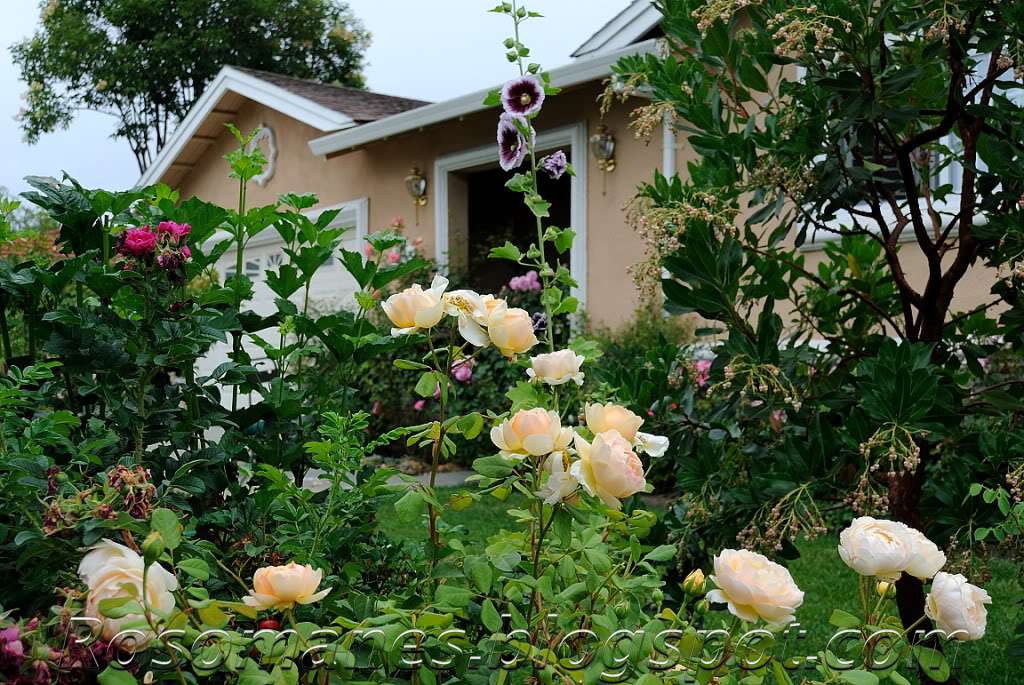
My personal preference is for a somewhat wild look without sharply defined shapes or spaces, and without carefully orchestrated color palettes. Something like this.


I like spiky plants with roses to break up the roses' rounded blooms. I have seen many pictures of roses growing with lavender and always wonder at the skill of the people who achieve that. In my garden, roses are mostly on regular sprinkler irrigation which lavender hates. Consequently all my lavender is dead except in one spot where I provide no water but there is some run-off from the neighbors' lawn irrigation. I wouldn't know how to achieve that on purpose... I miss that look though, and use purple and blue salvias, catmint and some penstemons for a somewhat similar effect.


I have a border of thyme along a section of the front yard. Thyme does well with sprinkler irrigation for a number of years and then declines. The roses are Carding Mill, Sophie's Perpetual and Lady Hillingdon.


Cranesbill and pelargoniums are a staple here and I grow a lot of them in my garden. The rose below is Sophie's Perpetual.


I prefer cranesbill with roses because the blooms are less showy and do not compete as much with roses.


Here is Margo Koster with cranesbill and thyme.


I like bacopa too, although mine do not seem to be long-lived. It is a nice unassuming ground cover that compliments roses well. The rose below is Jude the Obscure.


Verbena bonariensis is a tall coarse perennial, but useful for backfilling and providing color up on top. Here it is with Classic Woman.


I recently started planting hollihocks for vertical interest, and they have grown very well so far. Here is Creme de Cassis with Jude the Obscure.


Clematis is common with roses as it is a light airy vine (well, most of them) that comes in colors that compliment many roses so well. Here is Etoile Violette with Abraham Darby.
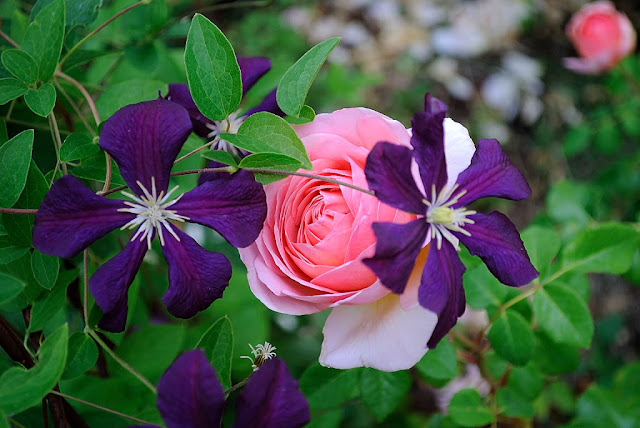

This is Crystal Fountain, a type II clematis. Type II clematis do not usually do well in warm climates, but this one has been pretty vigorous for me. I don't know how long lived mine will be as it is still young. I grow it over Mme Caroline Testout, cl.


True (non-purple) blue is pretty hard to come by in warm climate gardens. I like Bluebells (campanula rotundifolia) because they provide a wilder informal look. Mine have been in the ground in part shade for 3 years now and are doing well.


Another plant with sky-blue blooms is Cape Plumbago (plumbago auriculata), a tropical plant that could get quite big but mine thanksfully gets pruned every year by winter freezes. It was killed to the ground last winter but came back nicely. The roses are Sharifa Asma and Ebb Tide.


Here is salvia patens Blue Angel with a pink penstemon and Devoniensis. The salvia is one of the most saturated blues in the garden (along with Black-and-Blue salvia) but on its own is a very coarse plant. I planted it so that the clump is out of site and only the flower spikes are visible. Much better. It blooms from late spring to late summer.


I would like to mention gratefully my husband's artistic taste and flawless eye for color. He came up with this combination of Eugene de Beauharnais (purple) and Carding Mill (apricot), which never would have occurred to me on my own.


He also thought of planting Break o'Day with catmint. I am way too conventional to come up with such ideas. But it looks great.


Here is another rose with nepeta - a silvery pink Pretty Jessica goes beautifully with greyish purply blue.


I adore penstemons, and if I had more room I would start another collection. In addition to being healthy and fairly low maintenance plants with interesting blooms that come in many colors, penstemons are perfect companions for roses. They thrive in the same growing conditions and spiky leaves and flower stalks provide a nice contrast.


I miss wildflower meadows I used to see in my youth. It is strange to even talk about a meadow in my tiny garden, but I created a little border that looks like it to me with pink penstemon, alyssum, salvia Blue Angel and geranium Rozanne. The white rose is a young Devoniensis.


Bridal Wreath Spiraea (Spiraea cantoniensis 'Flore Pleno') is one of my favorite early spring-blooming shrubs (the other one being all varieties of loropetalum). The shrubs cover themselves with a profusion of small white double  blooms, and I readily forgive it its lanky growth habit, mildew and aphid infestations later in the year. The shrub to the right is the loropetalum rubrum "Razelberry".


My Snowball Viburum (Roseum) blooms right when most of my roses are at the peak of their spring flush. A really amazing sight that stops people in their track. Showball viburnums can grow into big airy vase-shaped shrubs here, but take well to pruning and can be kept smaller although the natural graceful habit of the plant will be lost. Here is mine blooming with Purple Pavement and Jude the Obscure.


And another picture of a Purple Pavement bloom inside the viburnum.


Wednesday, December 29, 2010

Pruning My David Austin Roses

"How shall I dare to tread upon the territory of the Rosarian? For nothing so exasperates the specialist as when the mere amateur comes along and blithers bright nonsense about his own ... pet subject ... . Therefore go I very daintily, for fear of the pruning knives of the National Rose Society banded unanimously against me." Brent Dickerson, The Old Rose Advisor quoting Reginald Farrer's In a Yorkshire Garden.


I grow about 20 David Austin roses, some grafted, some own root, and I have finally arrived at some elementary understanding of what I need to do with them at pruning time. This is by no means the definitive guide to pruning, but only a few observations on growth habits and pruning techniques. You can refer to My English roses post to see some bush shots in full bloom.

For the purposes of pruning, I divide all my English roses into two groups. Most roses in either group can be grown as free-standing shrubs or as climbers (at least in warm climates), and the grouping is based only on how blooms develop on individual plants, which makes pruning a lot easier for me.

1. Shrubby roses, with all canes terminating in blooms (somewhat like hybrid teas, but with a little more branching).

2. Climber-like roses, with lots of blooming shoots developing along main (basal) canes. These can still be free-standing shrubs.

Pruning the shrubby ones is mostly (but not always) straightforward.

Here is what my Sharifa Asma looks like pruned. I shorten all canes by about 1/3 and cut out the very weakest growth and any canes that grow inside the bush because they tend to die back. This is to me a much gentler pruning than I would do on a hybrid tea. It still blooms well and the blooms do not flop over. It does not send out long shoots and is one of those English roses, which, in my opinion, will not climb.


I prune my Heritage harder because it is a much larger rose (and I can't afford to give it all the space it wants to grab) and because canes are fairly thin and will droop if not shortened. I cut the size of my shrub by at least 1/2 and it is self-supporting this way, even though still floppy by the end of summer. This rose can make a good climber but I don't have room.


Geoff Hamilton is the reason why I say pruning shrubby Austins is not entirely straightforward.  It gave me easily 6' long basals with no branching. I cut the canes by about 1/3 to see if I can induce branching, but the only thing I got was a couple of tiny scraggly shoots a few inches long. It does not seem to take kindly to pruning. I no longer grow it.

The climber-like ones are the ones I like best. They are very generous with blooms,  every tiny twig is productive, and there is no dieback however little pruning I do.

To illustrate, here is a cane on Jude the Obscure. There are side branches at regular intervals all along the basal cane.  I leave as many of them as possible (which means pretty much all of them), and they all bloom. It does not seem to abandon even the weakest canes, and there is no dieback.


Pat Austin requires a little more work because the growth is more rampant.
It develops quite a few thin shoots inside the bush which I prune out not because they won't bloom (they will) but because I am too greedy to allow the rose to set bloom I won't see and because deadheading the inside of a prickly bush is not a task I will enjoy next year.


Because the growth is so dense, there is lots of damage from canes rubbing against each other. However, I have not seen any cases of severe canker, and not a single cane has died yet.

The more little branches I leave...


The more blooms I get in spring


Here is a cane on William Shakespeare 2000. I shorten all strong laterals till I am sure they can support clusters of heavy blooms, and remove the weakest ones because they sometimes die back.


Here is the whole bush pruned and still blooming.


Thursday, December 9, 2010

My English roses

I have a love and hate relationship with my English (Austin) roses. Some of them are great all the time, some are gorgeous in spring and lacklustre the rest of the year, and some are pretty bad no matter what I do. The trick is to find out which are the good ones before I buy them, and that's a trick I haven't entirely mastered yet. But here's what I learned about the ones I do have.

Pat Austin

I really love this rose. It  is a big one in California, mine wants to get to at least 8'x8' and I prune it pretty constantly. It is currently about two thirds the size of the Japanese maple next to it. It does throw out those long octopus arms that Austins are famous for in warm climates, but they can be pruned off easily as there are not too many of them. I always leave some of the weak growth at the bottom of my bush when I prune to give it a nicely clothed look in summer. It blooms from top to bottom and the foliage has no disease in my climate. The blooms are an unusual coppery orange color, and strongly tea-scented, but they do turn a greyish pink when they age (not pretty) and shatter quickly in the heat. They have no vase life to speak of. This rose does not bloom in regular flushes for me, but there are a few blooms on it almost constantly after a main spring flush. The spring flush comes rather late (in May)


but there are blooms on it every year at pruning time (December).  New canes are a pretty plum color, and notice how nice the leaves still look.

It sets hips for me pretty well and does hang on to spent blooms for awhile, so I always deadhead it. Here is what a hip looks like.


The bush has a nice rounded shape, and gives me new basals very generously. It does sometimes produce weird convoluted growth that no other rose does in my garden.


Jude the Obscure

I will grow this rose always because the fragrance is truly amazing. I wish there was a way to photograph it. David Austin describes it as having "a fruity note reminiscent of guava and sweet white wine". I am always sniffing it whenever it is in bloom. It gives me a generous spring flush and then some blooms on and off. There are no blooms to speak of in the fall. In fact, repeat is probably below average. However, no octopus arms on that one, and a beautiful bloom form as well. Petals drop cleanly and I have not noticed any hips. The foliage is clean and plentiful. A very nice rounded and mannerly bush shape and not very prickly. I find that every little twig will produce a bloom and I don't prune it hard.


The blooms last a couple of days on the bush (mine is in afternoon shade), and not much longer cut. They are never as fragrant in the vase for me as they are on the bush.


Heritage


Its most attractive qualities for me are strong fragrance and an almost total absence of prickles. I also like that particular shade of shell pink. It could be grown as a climber because the canes are fairly thin and quite long. I have to prune it pretty hard (cutting off about 1/2 of the canes) to keep it bushy. Still it is a large bush, maybe 6'x6' with year-round pruning, and it started throwing 10' long canes this summer. I like the look of cup-shaped blooms but the petal count is not high - they never ball but they last less than a day in the heat. No vase life. Petals drop off cleanly so the plant always looks nice. However, it sets hips readily and needs to be deadheaded anyway. Ripe hips are a pretty orange color so I leave some in the fall to create some winter interest.


Janet


I have had lots of problems with Janet. As a young plant, it kept throwing huge, gigantic canes, but thin, and clusters of heavy blooms plopped into the dirt all the time. The blooms are big and full of petals and refused to open. When they did open they were gorgeous and I was willing to wait and see what the rose will do once it matures.


I have moved it to a south facing site where I could tie the canes to an arbor and to a fence opposite it. At first the canes were still too weak to support the blooms and I had to tie them all (lots of work but pretty!).


This past summer it finally gave me two sturdy canes with lots of blooms that all opened (I counted upwards of 40 blooms on each cane). It still needs support but at least I don't have to tie up each individual bloom any more.


The blooms rarely show damage to the outer petals and have a soft peachy pink color.


Sometimes the color varies from a blush pink in a partly open bloom to a soft apricot as the bloom opens. Reminds me of Tea rose blooms.


The blooms have no fragrance, but the plant is very clean for me. This rose needs lots of space in a warm climate. The thick canes it has been giving me are 10' tall and very rigid, so I am not sure it can be grown as a climber. Blooms do last in a vase, but the color is often lost very quickly and they turn an ugly off-white.

I don't have a bush shot of it because so far, there is no bush:-) just a few very long canes.

Sharifa Asma

It is a very worthy rose with little to complain about. Its blush pink blooms are elegant and have a strong sweet fragrance. It blooms in regular flushes for me well into December. Growth habit is restrained and somewhat twiggy. The foliage is not very plentiful for me, and shows accumulated salt damage in late summer. Thrips seem to love it too. The blooms have a vase life of a few days and keep their fragrance well. Here it is in spring with William Shakespeare 2000 at the far left.


William Shakespeare 2000

This is one of the best roses in my garden. I love the old-fashioned perfect and richly colored rosettes, and wonderful fragrance. It is a really generous bloomer giving me steady flushes from May to November. There are almost always blooms on it, and there are quite a few even now.

Its growth habit is a little challenging. Canes grow almost horizontally with big clusters of blooms on top, or to put it better, on the side.  I have two of them flanking my driveway, one in full sun, the other in a little over half day sun, and the one in full sun is doing much better. Below is a picture of it.


Pretty Jessica

A very easy care rose - no prickles, no octopus canes. No fall bloom either for me. The few blooms I have seen are all nicely formed, very fragrant, open well and self-clean. So far I have not been very impressed, although my rose is still young and will perhaps change as it matures.  The bush is probably 3'x2' and shows no signs of bolting. Mostly, it just has no presence...


Crown Princess Margareta

Big! I have two of them on an arbor and they like this arrangement. This cultivar gives me thick  long canes growing straight up and is capable of growing huge laterals off completely vertical canes. It creates lots of short blooming shoots off canes bent horizontally, like this.


It has no disease in my garden, but unfortunately, no fragrance either and little rebloom. I have seen one fall bloom on my two big bushes so far. It does bloom intermittently through the summer. The blooms never ball. I keep it solely for its generous spring display of luscious heavy apricot rosettes.


Bishop's Castle


I just can't fall in love with it. It blooms in generous flushes, the blooms are lovely to look at and quite fragrant. The leaves are mostly clean although there is sometimes a bit of mildew on the bloom necks. I cut it quite often for the house, and the blooms last a couple of days in a vase. The bad part is a profusion of horrible tiny prickles going all the way to the neck of the bloom making it one of the most painful roses to handle for cutting, and the incredibly long thin canes it grows. It does remind me of a spider frequently. The blooms mostly face straight down (a tendency not improved by overhead irrigation), and I almost have to lie down to look at them. Oh well, they are pretty...

It has never inspired me to take a full bush shot...


Gertrude Jekyll

A very temperamental beauty. Gorgeous blooms with a heavenly fragrance coupled with unruly aggressive growth habit and lots of thorns.  Last year it kept growing huge octopus arms that I kept cutting back and gave me no fall bloom. This year I decided to peg it, but it gave me not a one long cane in a whole year, but lots of fall blooms for a change. I am looking forward to see if it might make up its mind as to which habit it prefers, but maybe it will just keep surprising me.


Christopher Marlowe

It will be gone soon. It is not a bush but a small climber or pillar rose with thin-necked blooms. I gave it three years to see if it would stand up on its own and it never did. A drunken octopus. I will miss the nicely shaped blooms in pretty and unusual colors and clean small elegant leaves, but enough is enough.


The blooms do have a long vase life of about a week if cut as an opening bud and open well on the bush. They are not strongly fragrant to my nose and persist on a bush long after they decently should.


Abraham Darby

This one will be gone this spring. Mine has never had rust that so many other people seemed to have problems with, but it has never developed any good strong canes. The blooms are too heavy, and the canes are constantly broken by overhead irrigation and the bush never grew tall enough to lift the blooms up over the sprinklers. I have seen pictures of it showing a huge rose, but mine has been 4' tall long enough.


Golden Celebration

This rose produces one of the most beautifully formed blooms in my garden. They are a saturated orangey-yellow color with a wonderful citrusy fragrance.  The spring display is amazing, but repeat is probably below average.

I am trying to grow mine as a climber over an arbor, and so far the result has not been spectacular.  The bottom growth is very sparse, and canes need to be bent to branch out. My plant is still young, and I am willing to wait and see what it does. One of my neighbors grows it as a large shrub (perhaps 5'x5') and it looks much better this way.


Carding Mill

It is a very vigorous trouble free rose for me.  The shrub is bushy and compact, no octopus arms, no floppy canes, the blooms are held upright in small clusters. They consistently have great form, and an overpowering fragrance that David Austin classifies as "myrrh". The myrrh fragrance is not sweet, and people seem to be divided in either loving or hating it.

The color is usually apricot but sometimes turns pink in the heat. The blooms rarely crisp and usually last at least a few days.  It has the best heat tolerance of all my Austins. It takes well to pruning and has no foliar disease in my climate.


Geoff Hamilton

Gone. One after another long cane with a couple of blooms on top. The canes resist cutting back and will not regrow well if pruned hard. Refused to branch out. The blooms often had ruined outer petals and there was not enough fragrance. There was not enough rebloom either. I really begrudged it the valuable space it took in my small garden. Finally our gardener sliced through the bud union with a lawn edger and saved me the trouble of explaining to my husband why I want to get rid of a healthy sometimes blooming rose.